Nigerian Igbo
Funeral Ceremony
second burial

2nd Burial Rites
As one of the Igbo traditions, death is not the final end but a transition into another realm, just as with other indigenous tribes all over the world. This can be accomplished with a Second Burial ceremony for the deceased. Determining how the ceremony will go depends on who the person is and will take place from one month to a year after his/her death. This is not like an ordinary funeral with drab ambiance, depressing music with crying and a box of tissues being passed around we westerners are use to. It is full of colorful art and instrumental tribal music that is anything but depressing. Now I'm not saying that no one cries during this Igbo burial, because I'm sure there are people crying and upset, I'm just stating that it is not anything we normally are used to in a funeral.
This second burial will usually take place months after the first burial and is treated as more of a celebration rather than a somber event. Singing and dancing in their best clothing is involved, which tells the community of this event. When there is a death, preparations for this ceremony will take place. It's a spiritual event where animal sacrifices, feasting, poetry, dance and music are combined together to a form this dramatic burial which lasts from one day to several weeks depending upon who it is and how wealthy they were. Family and friends of the deceased will pay their respect and grieve with these colorful and eventful funeral traditions this ceremony holds. These rites are known as "ikwa ozu" to the Igbo people, meaning "celebrating the dead." Ikwa ozu will be different from community to community. Without the second burial the deceased will unfortunately stay in Limbo.
For example, Chinua Achebe, a known writer from Nigeria, needed a second burial ceremony to join his ancestors. Just because he was well known, accomplished and successful doesn't mean he can automatically go into this new spiritual world with his ancestors. He too needed this Second Burial ceremony to join them. Basically, just about everyone needs this to enter the spiritual world.
Chinua Achebe was a novelist, poet, professor and critic, who wrote the book "Things Fall Apart." His ceremony took place on May 24 and 25, 2013. Like some Igbo people who can afford it, can immediately have this ceremony rather than waiting months, his ceremony took place immediately (he died March 21, 2013).
The elderly
When the elderly dies, whether a man or a woman, his/her body is immediately stretched out on plantain leaves, sponged down and rubbed with Camwood dye which marks it as sacred. The body will then be laid out in the living room with their feet facing the entry way, if they are a man. For a woman, she will usually be seated upright and carried away to their ancestral burial village to be buried on a stretcher.
After the body has been prepared for their passage into this new realm a wake is held, which will go on all night. The oldest son welcomes the community in their home with Kola nuts and palm wine, which are important symbols of the Igbo culture. The ancestor spirits are summoned into the home with prayers and beverages. These spirits then escort the deceased to this new world. When the early morning arrives, gunshots are fired off to tell the rest of the village of the death. When the wake is over, the body, along with cloth and some of their valued personal possessions, will be buried in the living room by young men encased in wooden planks.
Women and widowhood rites
When a husband dies, the new widow will begin to go through widowhood rituals. As I mentioned earlier, it depends on the man's status what practices will be performed. For an ordinary man, the wife/wives (depending on how many he had) are expected to immediately go into a traumatic type of wailing during the hours of 5am and 6am for 4 or more days. She will beat on her chest, fling her arms around and fall to the floor. Other women will then surround and restrain her. She will then be forced to sit on the ground while these women sit around her. Not all subgroups of the Igbo do the same rituals. For instance, the wife/wives of the Mbaise group are not allowed to cry out loud until the appropriate arrangements, which will inform others of this death, such as relatives and in-laws, have been made. On the other hand, in the Owerri group, the widow must shout and scream in tears over his death. If she does not do this, she will be punished and fined. In fact, however, some widows will ignore this. The "born-again Christian" widows will not perform any rituals nor cry over their husbands death.
The Chief
The Igbo people are known to have the most intricate burial and funeral ceremonies. The one who gets the most complex ceremony is the chief's. They can also become very bloody, so this may sound a little gory and graphic to some.
The first thing that goes on during the Chiefs ceremony is the washing of his body in the death chamber. The body is then placed on an “ojo” (a high bush table) and is covered in cloth, strings, manila, and young palm leaves, which for these people, symbolizes rebirth (as they will be born into this new spirit world). An arrangement of family and friends, singing and dancing will be held by his oldest daughter. His son-in-law, the chief’s daughter’s husband, will lay an eagle feather, slain by a blood relative, on top of the corpse. Sacrifices for the chief are next. Animals will be sacrificed first for their abilities they possess. These sacrifices will give the chief these animal abilities in his next world. Now remember, this is from another culture, so they do things a lot different than our western cultures. I wasn't too thrilled typing it, but this is part of their ritual for them to go on.
The first to be sacrificed will be a dog because of its power of having senses beyond a humans’ and to see danger and evil coming before anyone else. The dog is beheaded and the children draw a circle around the corpse with the dog’s blood. The next to be sacrificed is a cat for its night vision, which gives the chief good eyesight in this new world. An eagle for its eyesight is next, and a parrot for its clear voice. These animal sacrifices usually depend on the rarity and price of the animal. For example, a goat and a sheep are the most common because they are cheaper and less of a prestige. On the other hand, cows are considered to be of great honor along with a horse, which is the most exceptional. Women however are not given horses.
At this time the relatives on the chief’s mother side will be doing the sacrificing. A goat for its strong feet will be first. Next are the slaves’ wives. The “Aho’m” (the special slave wife) will be killed and thrown in his grave. These wives throats will be cut at the tree where ale is worshipped and their blood is poured at the trees roots to fertilize it. The rest of the wives will have their arms and legs broken by the bravest, strongest men who can do these tasks. They then will be buried alive along with the chief, exactly how many of these sacrifices that take place depends on the chief. If he was wealthy enough, he will have had more wives, thus, more will be slain.
The tribe then signals the ancestors by playing the drums and trumpets for the chief’s arrival. They will close the grave, but leave a small opening for the final sacrifice of a man from another tribe, where he will be beheaded. His head is then placed in the grave through this small opening that was purposely left open. The “Obiri” (the death chamber) will be decorated with skulls of the victims and a feast of the flesh from the animals and humans that were sacrificed will be gathered for the family.
During the next 3 months the widows of the chief will sleep in the Obiri and guard the ojo. After the 3 months this Obiri is torn down while the materials and cloths are burned. For a year these widows will have to wear mourning clothes.
Bad Deaths
Not everyone in Igboland will get a burial ceremony. For these people who do not get a ceremony have died from a “Bad Death” or an "embarrassing death," thus will not go into this new spirit world with their ancestors. These bad deaths include women who have no son, women who die in confinement, a child who dies before they get their teeth in, suicides and those who have passed on during the sacred month. Instead of being buried, their bodies are thrown into bushes. They also believe that certain people should be put to death if they put shame to their group, the "embarrassing deaths" (which sounds cruel, however, this is a different culture as I mentioned). These people who have put shame to their group are twin mothers, twins, children whose upper teeth come in first, children who are born feet first, boys with one testicle, men with elephantiasis of the scrotum and Lepers. These people will be thrown away in a bush in secret.
the ancestors
Ndebunze or Ndichie are deceased ancestors who are in the spirit world, ala mmuo. Odinani comprises the traditional religious practice and cultural beliefs of the Igbo people. In Odinani, it is believed that the dead ancestors are the invisible community members and their role in this community in conjunction with Ala, is to protect the community from epidemics and strife like famine and small pox. At a man's father's funeral there is hierarchy in Igbo culture of animals that will be killed and eaten in his honor, such as they do in the burial ceremony for the Chief.
Reincarnation
Another belief of theirs besides bad deaths is reincarnation. Reincarnation is the belief that the soul comes back to earth in some other form. It is known for the Igbo people to believe in this theory or to them known as “Ilo uwa,” meaning a return to the world. Although some have a strong influence on Christianity, reincarnation has remained their belief. “Ala-muo” the word they use for the life beyond, means the inner realms, which are not just for folk stories. In this Ala-muo, they believe that their ancestors are living and speak for them before “Chi-na-eke” (the god that creates) and “Ofo-na ogu” (the gods operating force), that balances things in nature, such as climate conditions that are vital for their agriculture. They believe their dead relations reside after physical death and from there would reincarnate probably to those that were kin in their past life.
This reincarnation process belief varies from person to person. Some believe that man reincarnates with his former body and characteristics. Merits and demerits in a person’s former life determine their amount on reincarnation in a new infant’s body that can grow up into a healthy adult’s body. The majority of he Igbo people have this belief. Even with the Christianity doctrine, there has been great evidence forcing some, many Nigerian Christians, to think twice of Christianity and go back to their old beliefs and traditions.
This belief goes further than just a “hope it happens” mentality. There is evidence to prove this reincarnation occurs. For instance, body markings of the deceased will reappear on the body of a new born. Scars from the cuffs from the mentally ill on wrists and/or ankles have been known to show up. Along with burn marks from people who were burned to death. When these specific markings appear, it provides enough proof for them that reincarnation has occurred. Some fear these types of reincarnations and will not associate with them. Reincarnations in people with above average intellect and physical abilities have also been known as well.


Igbo head stones.
Chinua Achebe's ceremony
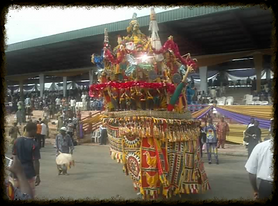
As you can notice the colorfulness the Igbo have in their Burial Ceremony.

Uxurhe Ancestral Staffs
Igbo 2nd burial ceremony


The corpse all dressed up in the death chamber


© 2015 by Larissa Hostetter. Created with Wix.com